





A few scientific facts about the world we cannot see — the microworld.
MicroFacts
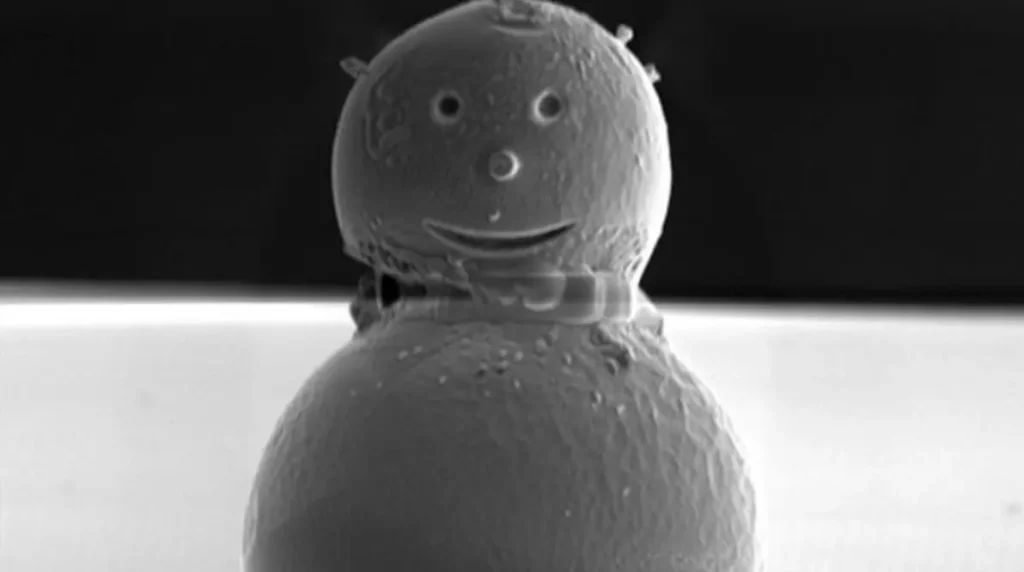
0.001 mm – the diameter of a platinum droplet used to make the nose of the world’s smallest snowman, crafted from tin micro-particles by David Cox of the UK’s National Physical Laboratory. The snowman’s eyes and mouth were etched using an ion beam, and the diameter of its base sphere is just 0.01 mm — several times thinner than a human hair.
1 minute – and about 70 nerve cells die in the human brain. A newborn’s cerebral cortex contains around 14 billion neurons — and that number never increases. The good news: IQ depends not on the number of neurons but on the number of connections between them.
Over 6 quintillion (a 1 followed by 18 zeros) electrons pass through any given point in an electric current every second at a current of 1 ampere. And no one sees it happen!
75 kilometers of nerves are hidden inside the body of an average adult. Think about that before you decide to get on someone’s nerves — the process might take a while.
2–4 days – that’s how long leukocytes live in the human body. Red blood cells are luckier: they last 3–4 months, even though they’re constantly working. Each red blood cell completes a full circuit through the human body in 20 seconds via the systemic circulation, and in just 4–5 seconds through the pulmonary circulation.
5 nonillion (5 × 10³⁰) bacteria live on Earth, weighing approximately 350 to 550 billion tons — at least according to scientists. By the way, “bacterium” and “bacillus” mean the same thing: the first term comes from Greek, the second from Latin.
1676 – the year Dutch scientist Antonie van Leeuwenhoek first observed bacteria through a microscope. He called them “animalcules.”
3000:1 – that’s the maximum magnification of the best optical microscope, allowing us to see particles as small as 0.1–0.2 micrometers. Electron microscopes, however, can magnify objects up to 750,000 times.
If you like to drink coffee, then read these facts – A Piggy Bank of Coffee Facts
10 trillion bacteria inhabit the human gastrointestinal tract. They synthesize essential amino acids and vitamins, break down starches and proteins, and regulate the immune system. In fact, there are 10 times more bacterial cells in the human body than human cells.
140 km/h (87 mph) – that’s the speed at which a rhinovirus (the common cold virus) travels. It doesn’t go farther than 4 meters (13 feet), but you should still sneeze into a tissue — science knows of more than a hundred different rhinoviruses.
0.001 mm – the diameter of a platinum droplet used to make the nose of the world’s smallest snowman, crafted from tin micro-particles by David Cox of the UK’s National Physical Laboratory. The snowman’s eyes and mouth were etched using an ion beam, and the diameter of its base sphere is just 0.01 mm — several times thinner than a human hair.