




Once upon a time, physicists agreed that radiation is the ability of a material object to emit packets of energy in the form of both waves and particles. That, of course, is an extremely simplified definition — but hey, you work with what you’ve got. What we managed to grasp, we now pass on to you.
There are countless monographs, dissertations, and textbooks written about radiation. But recent research puzzles not only physicists, poets, and high school teachers — even Einstein’s ghost is reportedly baffled by what’s going on inside the Large Hadron Collider. What makes matters worse is the fact that most of these waves and particles are completely invisible to us — in fact, we can’t see any waves at all, except for good old sunlight.
PARTICLES
Let’s try to make some sense of it. Pretty much any object can emit radiation if it’s sufficiently heated or excited (well, almost any object). In an excited state, atomic nuclei, protons, electrons, and other tiny subatomic components begin to move chaotically, fly off in search of adventure, and crash into other bodies — causing those particles to enter a jittery frenzy. These streams of flying particles are what we call radiation.
Alpha Radiation
To put it simply, alpha particles are heavy, slow-moving helium-4 nuclei. Large and clumsy, these alpha particles — the result of nuclear reactions — barely penetrate anything: in inanimate matter, they travel only about 3.7 cm; in living organisms, just 0.05 mm. So if you wrap yourself in a few layers of toilet paper, you can safely block an alpha stream. But ingesting radionuclides? That’s a guaranteed slow and painful death.
Benefits
None, really — unless you count radon baths. Radon is a radium isotope whose radiation is believed to help with depression, gout, and certain skin conditions. Just don’t overdo it.
Hazards
High-intensity alpha radiation can damage DNA and cell membranes, but it’s easily blocked by protective clothing and doesn’t penetrate buildings at all.
Beta Radiation
This is a stream of electrons or positrons, again produced by nuclear reactions. Beta particles can penetrate living tissue to a depth of only a few centimeters, and a few millimeters of aluminum are enough to stop them.
Benefits
When electrons hit a phosphor — a substance that converts radiation into visible light — the material begins to glow. This is exactly what happens when you switch on a regular fluorescent lamp.
Hazards
If you’re exposed to an unshielded beta particle stream, your biggest concern is likely to be skin burns. Prolonged exposure can lead to full-blown radiation sickness.
INTERESTING ARTICLE — Facts About the Microworld in Numbers
Gamma Radiation
This is high-energy radiation made up of fast-moving photons, which are absorbed by lead or other heavy elements.
Benefits
Gamma rays are useful for the same reason they’re dangerous: their ability to destroy living cells. Oncologists use precisely focused gamma rays to target and kill cancerous tumors.
Hazards
It’s believed that prehistoric mollusks and 90% of all life during the Ordovician period (443 million years ago) were wiped out in agonizing pain due to a burst of cosmic gamma radiation — likely from a supernova somewhere deep in space.
Here on Earth, we’re constantly exposed to background gamma radiation — from space and from nuclear reactions in the Earth’s crust. In certain regions of France, India, Brazil, and elsewhere, natural gamma levels are several times higher than average, yet locals seem to thrive just fine.
RADIO WAVES
Electromagnetic radiation with frequencies ranging from 3 kilohertz (kHz) to 3,000 gigahertz (GHz) is also invisible, though it surrounds us everywhere. These waves vary in length from 100,000 kilometers to 0.1 millimeters.
UHF (Ultra High Frequency)
These are decimeter radio waves, ranging from 1 meter to 10 centimeters in length, with frequencies between 300 and 3,000 MHz.
Benefits
Back in the day, the UHF machine in the school nurse’s office was every sickly kid’s golden ticket to skip math class. In truth, UHF therapy can treat not just the common cold but a wide range of ailments — by converting radiation into thermal energy.
Hazards
The same quality that makes UHF waves therapeutic — deep penetration into tissue — is also what makes them risky. In the dark realm of radio waves, cancer cells can grow rapidly.
Some say intelligence agencies use UHF to quietly eliminate undesirables: prolonged exposure to high levels of UHF radiation can kill a person, while the autopsy reveals only the symptoms of a seemingly ordinary — but fatal — disease. Convenient, isn’t it?
Microwaves (SHF – Super High Frequency)
Super high-frequency radiation, ranging from 3 to 300 GHz, with wavelengths between 30 and 0.1 centimeters.
Benefits
Microwave ovens, cell phones, Bluetooth, WiFi, and WiMAX — all of them rely on SHF waves to function, which is exactly why there’s so much debate about whether they’re dangerous or not.
Hazards
In large doses, SHF radiation can suppress brain activity, damage the nervous system and the heart. Directed and prolonged high-frequency exposure can allegedly cause memory loss, madness, or even mind control — enough to turn even the strongest-willed person into a vegetable.
In short: sleeping with your head inside a working microwave for 20 years is unhealthy. No — extremely unhealthy! In all other scenarios (when the device is off, or you’re not glued to it 24/7), SHF radiation simply doesn’t reach you.
Infrasound
These are waves longer than 25 meters, technically sound waves — if only we could hear frequencies between 25 and 0.01 Hz. But they do exist: created by vibrations in air, water, or the Earth itself — like during earthquakes or tsunamis. Even cars speeding along the highway generate infrasound.
Benefits
The only clear beneficiaries are whales, who use infrasound to communicate over long distances.
Hazards
If you’re not a whale, frequencies around 7 Hz — which match the brain’s natural rhythms — can cause nausea, ringing in the ears, blurred vision, and unexplainable fear. The stronger the infrasound exposure, the more severely it affects the brain and heart; long-term exposure may even lead to complete blindness.
Visible Light
Yes, the light we see is also radiation — although the portion visible to the human eye is just a tiny slice of the full spectrum. The rest can only be detected using special instruments.
Infrared Radiation
Starts just beyond the red end of the visible spectrum. Anything warm emits infrared waves — including the human body.
Benefits
Pleasant warmth and cozy sensations — especially if the infrared source happens to have long legs, plump lips, and a well-defined bust.
Hazards
None, as long as you avoid overheating.
Ultraviolet Radiation
The part of sunlight mentioned on every pair of sunglasses and bottle of sunscreen. It sits right next to the pheasant in the spectrum — in other words, just past the visible violet range.
Benefits
In moderation, UV rays help the body produce vitamin D and give winter-pale skin a nice golden tan.
Hazards
Too much sunbathing or tanning booth exposure can cause malignant melanoma, basal cell carcinoma, photoaging, and various forms of blindness (chicken, polar, and plain old regular), cataracts, and conjunctivitis. In other words — dosage is everything.
Top 4 Radiation Types
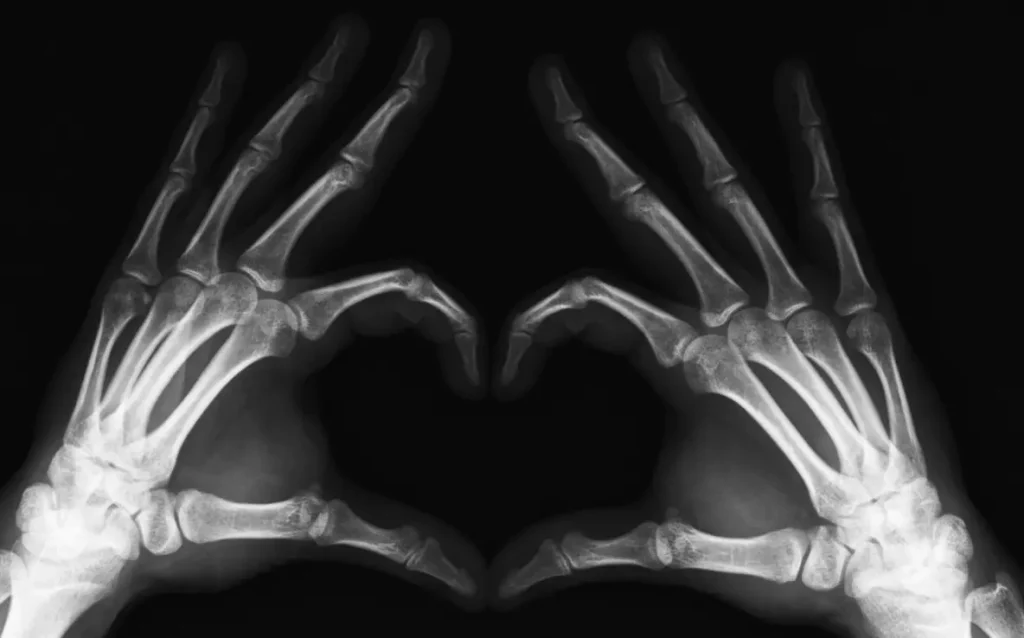
Most Famous – X-rays
One day, German physicist Wilhelm Conrad Röntgen accidentally discovered a type of radiation that could pass through opaque objects and expose photographic plates. By 1919, X-ray tubes were widely used to detect broken bones, and crafty salesmen were marketing special “X-ray binoculars” to peek at women.
Röntgen himself was a humble man — he never patented his discovery and made no claims to profit. He became the first-ever Nobel Prize laureate in Physics and generously donated the money to help rebuild post-war Germany. He died in poverty and solitude from cancer — like many early physicists who worked with radioactive materials.
Most Popular – The Aura
Personal radiation emitted by living beings, visible only to KGB agents, village healers, and assorted psychics. Essentially, it’s a glow (of one or multiple colors) surrounding the body: a healthy person radiates a bright aura extending up to 1.5 meters, while a tired or sick individual barely glows 10 centimeters, with dark patches (holes) throughout.
The aura was first photographed in 1939 by researchers Semyon and Valentina Kirlian, who studied the glow effect caused by electric discharge on various surfaces.
Most Profitable – Hartmann Grid
A network of bioenergetic lines crisscrossing the Earth like invisible meridians and parallels, spaced roughly 1.5 to 2 meters apart. They originate deep underground and stretch into space, passing effortlessly through concrete, lead, and anything else. Active radicals, electrons, and protons gather along the lines, and at intersections, “geopathogenic zones” around 30 cm in diameter are said to form — spots allegedly responsible for a host of ailments in both children and adults.
Whether true or not is unknown — but terrified clients happily pay good money to specialists who can detect and neutralize these sinister spots.
Most Energetic – Psi Rays
Just mentioning them makes hardcore materialists foam at the mouth, throw tomatoes, and yank out their own hair — and anyone else’s within reach. Psi rays aren’t recognized by mainstream physics or medicine (unlike the Inquisition, which enthusiastically roasted citizens blessed with excessive psychic energy).
Nevertheless, many believe in their existence: that they heal without drugs and help solve life’s problems. Some even fear becoming victims of remote “psi manipulation” — after which, they might murder their neighbors, walk to Antarctica barefoot, and declare themselves emperors of the penguins.